PCOD vs PCOS: What's the Real Difference? Ayurvedic Treatment for Both
✅ The Short Answer:
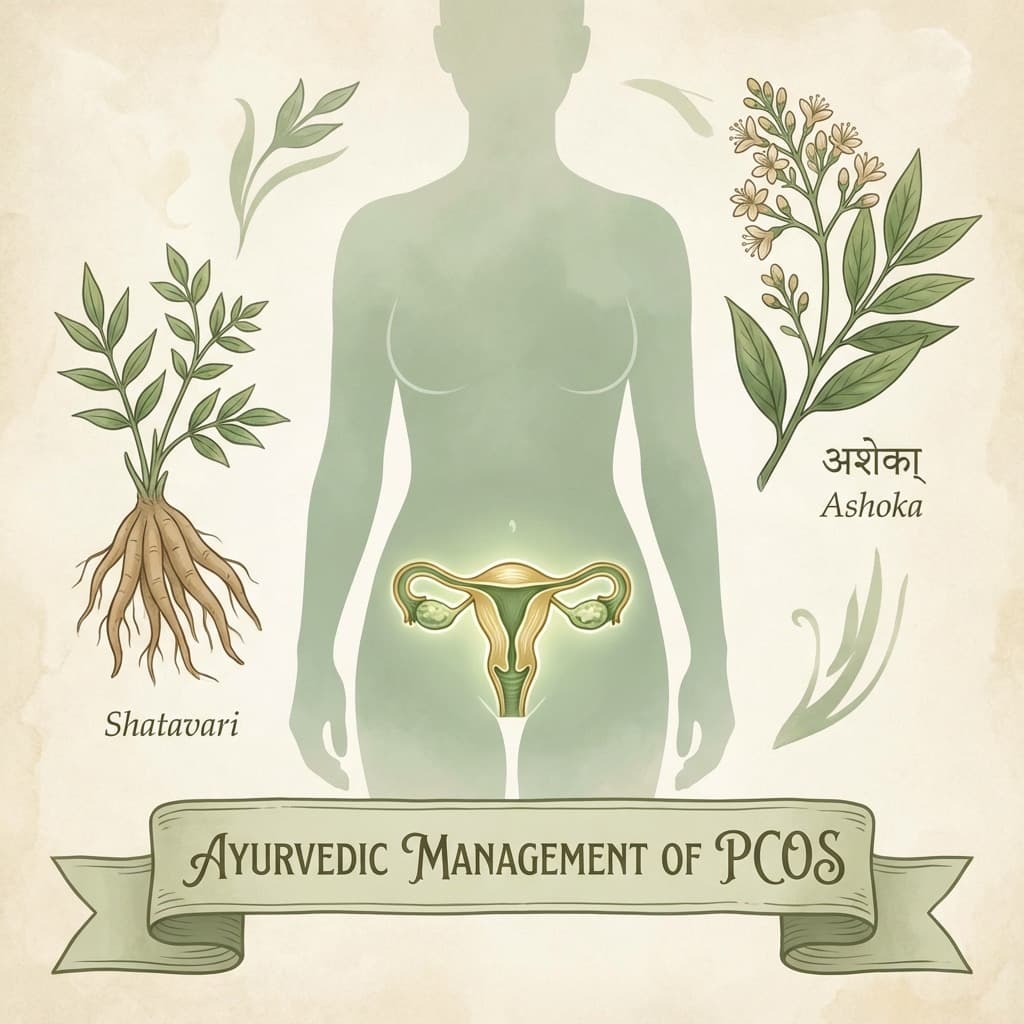
PCOD is a milder ovarian condition where immature eggs make the ovary bulky, often reversible with diet alone. PCOS is a serious metabolic syndrome involving high androgens, insulin resistance, and anovulation requiring deep Ayurvedic treatment. In Ayurveda, PCOD is early-stage Kapha blockage (Sanga) while PCOS is a Tridosha crisis affecting deep tissues. Both respond well to Ayurvedic protocols but PCOS needs 3-6 months of systematic treatment.
— Dr. Arti Singh (BAMS)
Medically Reviewed by Dr. Arti Singh (B.A.M.S.) | Last Updated: January 8, 2026 | Next Review Date: July 2027
Educational Purpose: The information in this article is written for educational and general information purposes only. It is not intended to be a substitute for professional medical advice, diagnosis, or treatment. Always consult a certified B.A.M.S. Ayurvedic physician or your primary healthcare provider before starting any herbal regimen, especially if you are currently taking hormonal or prescription medication.
"Doctor, I have cysts in my ovaries. My ultrasound says 'Bulky Ovaries'. Is it PCOD or PCOS? Will I ever be able to conceive?"
This is the most common, anxiety-filled question I hear in my clinical practice in Patna. Every day, young women—sometimes as young as 16—walk into my clinic clutching ultrasound reports, terrified by the word "Polycystic."
There is a massive confusion today. Many women (and even some health blogs) use the terms PCOD (Polycystic Ovarian Disease) and PCOS (Polycystic Ovary Syndrome) interchangeably. But in the eyes of Ayurveda—and detailed pathology—they are distinct conditions. One is a warning sign; the other is a metabolic storm. One is often easily reversible with diet; the other requires deep cellular detoxification.
In this comprehensive guide, I will break down the differences from an Ayurvedic lens, explain why this is happening to a generation of women, and provide a detailed roadmap to healing—without relying solely on synthetic pills.
PCOD vs. PCOS: The Core Difference
To treat your condition effectively, you must first name it correctly. Let’s look at the fundamental distinctions.
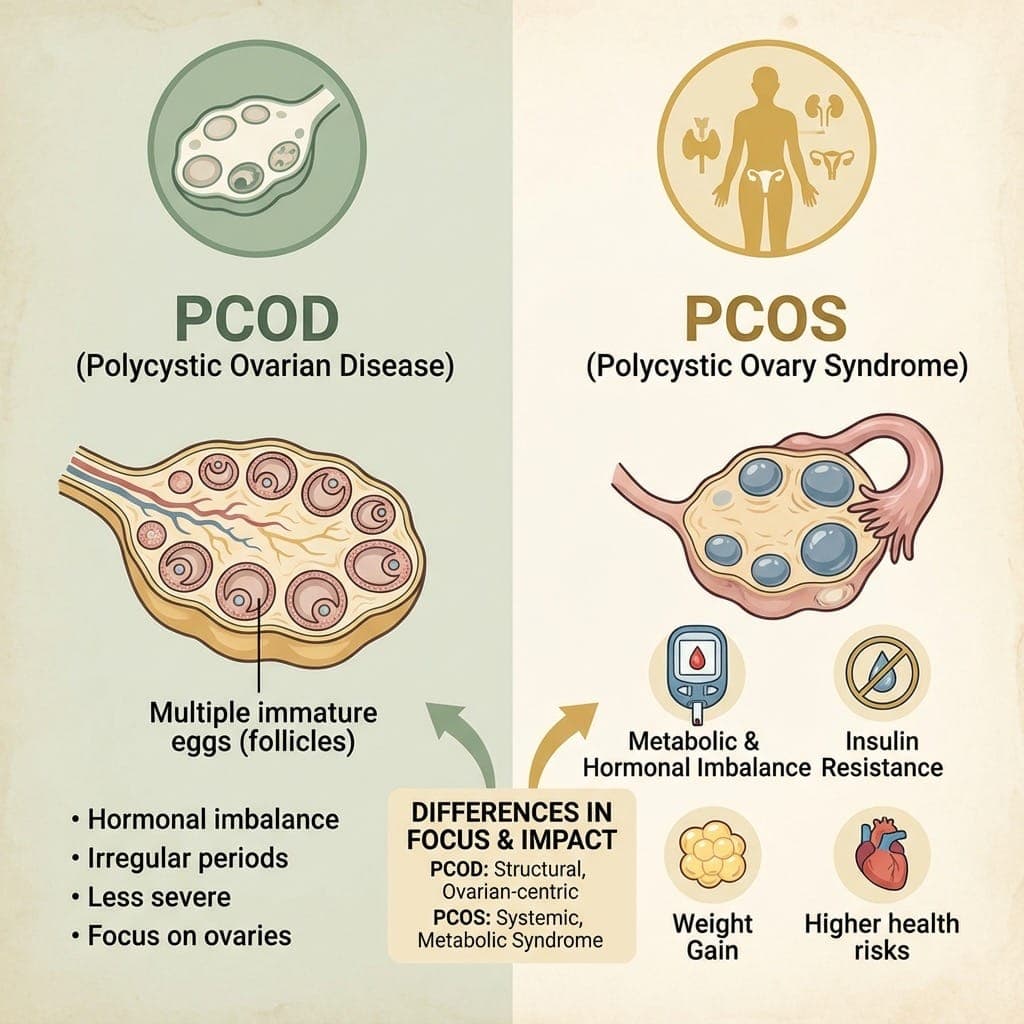
| Feature | PCOD (Disease) | PCOS (Syndrome) |
|---|---|---|
| What is it? | Ovaries release immature eggs due to hormonal imbalance. Ovaries become bulky. | A severe metabolic disorder. High male hormones (androgens) + cysts + insulin issues. |
| Severity | Milder. Often "silent" (asymptomatic). | Serious. Affects whole body (skin, hair, weight, mood). |
| Menstruation | Periods may be regular or slightly delayed vs. (e.g., 35-40 day cycles). | Periods often stop (Amenorrhea) or are extremely heavy/irregular. |
| Fertility Impact | Low Risk. Pregnancy is very possible with minor lifestyle tweaks. | High Risk. A leading cause of anovulatory infertility. Needs treatment. |
| Visible Signs | Usually none or mild weight gain around the belly. | Facial hair (Hirsutism), Balding, Severe Acne, Dark neck patches. |
| Ayurvedic Diagnosis | Kapha blockage (Sanga) in the ovaries. Reversible. | Tridosha Imbalance (Vata+Pitta+Kapha) affecting deep tissues (Dhatus). |
1. PCOD: The "Wake Up Call"
Polycystic Ovarian Disease (PCOD) is essentially an imbalance of quantity. In a healthy cycle, usually one dominant follicle matures and releases an egg (Ovulation). In PCOD, due to stress or poor diet, the ovaries produce many immature or partially mature eggs.
Because these eggs don't mature fully, they don't rupture. They remain in the ovary, making it look "bulky" on an ultrasound.
💡 Ayurvedic Insight
Ayurveda sees PCOD as early-stage Kapha Avarana (blockage by Kapha). The metabolic fire (Agni) has slowed down due to heavy, sweet foods or lack of movement. The "channels" (Srotas) of the ovary are getting clogged with sticky Ama (toxins), but the damage hasn't reached the deeper tissues yet. The body is whispering, not screaming.
2. PCOS: The "Systemic Crisis"
Polycystic Ovary Syndrome (PCOS) is a syndrome—a collection of symptoms. It is a metabolic disorder that involves the endocrine system. The key culprits here are High Androgens (Male Hormones like Testosterone) and Insulin Resistance.
When you have PCOS:
- The Brain-Ovary Disconnect: The specific hormones from the brain (LH and FSH) lose their rhythm. LH levels spike abnormally high.
- The Insulin Spike: Your body makes insulin, but your cells don't listen to it (Resistance). So, the pancreas pumps out more insulin. High insulin tells the ovaries: "Make more Testosterone!"
- The Result: No ovulation. No periods. Male pattern hair growth. Severe acne.
Ayurvedic Pathogenesis (Samprapti)
Ancient texts like Charaka Samhita don't use the word "PCOS," but they describe Yonivyapad (Uterine disorders) that match perfectly. We look at the root cause:
1. Kapha-Meda Avarana
Consumed too much sugar, bakery items, or slept during the day? This increases Kapha (Earth/Water) and Meda (Fat). This heavy, sticky energy wraps around Vata (Air/Movement). Vata is responsible for popping the egg out. When Vata is blocked by Kapha, the egg is stuck. Result: Cyst.
2. Pitta Kshaya (Low Metabolic Heat)
Menstruation requires heat (Agneya guna). If your Pitta is low (slow metabolism) or blocked, the blood doesn't flow. It accumulates. Alternatively, if Pitta is toxic (Vidagdha), it burns the follicles, leading to poor egg quality.
The Road to Recovery: Ayurvedic Protocol
The beauty of Ayurveda is that we don't just force a "withdrawal bleed" with a pill. We aim to restart the body's own rhythm.
Step 1: Deepana & Pachana (Igniting the Fire)
We cannot treat the ovaries if the gut is sluggish. We first burn the Ama (toxins).
- Remedy: Start your day with warm water + 1 tsp lemon + 1/2 tsp crushed ginger. No honey if the water is hot!
- Why? Ginger scrapes away the Kapha mucus lining the gut.
Step 2: Vatanulomana (Correcting the Flow)
We need to point the Vata energy downwards (Apana Vayu) to induce periods.
- Remedy: Dasamoola Arishta or simple sesame seed laddu/tea (Til) used 5 days before expected date.
- Caution: Do not use heating herbs like Sesame if you diagnose as Pitta-type (heavy bleeding or heat issues).
Step 3: Lekhana (Scraping the Cysts)
For stubborn PCOS with weight gain, we use "Scraping" herbs to dissolve the fat and cysts.
- Kanchanar Guggulu: The most famous Ayurvedic formula for any glandular swelling or cyst. It must be taken under doctor supervision.
- Varunadi Kashayam: A decoction that helps break down the outer covering of the cysts.
Your 7-Day "Hormone Reset" Diet Plan
This plan focuses on Lekhana (scraping fat) and stabilizing insulin. Use this as a template.
| Time | The Plan |
|---|---|
| 7:00 AM | Warm Water (2 glasses) + 1 pinch Cinnamon powder + 5 soaked Almonds |
| 8:30 AM | Moong Dal Chilla (Pancakes) with Mint Chutney OR Oats Upma with lots of veggies |
| 11:00 AM | 1 glass Buttermilk (Takra) with roasted cumin + pinch of Asafoetida (Hing) |
| 1:30 PM | 1 Millet Roti (Jowar/Bajra) + 1 bowl Seasonal Sabzi (Gourd/Beans) + 1 small bowl Dal |
| 5:00 PM | Herbal Tea (CCF Tea) + Roasted Makhana (Foxnuts) |
| 7:30 PM | Light Soup (Pumpkin/Lentil) OR Khichdi with very little rice and more moong dal |
Yoga for PCOD/PCOS
You don't need gym cardio. You need to massage the pelvic organs.
Butterfly Pose (Baddha Konasana)
Opens the pelvic floor, increases blood flow to ovaries.
Cobra Pose (Bhujangasana)
Compresses and releases the ovarian area, reducing stress.
Bow Pose (Dhanurasana)
Intense massage for the reproductive organs and digestive fire.
Real Clinical Insight (Case Study)
Patient Story: Riya, 24 years old
(Name changed for privacy)
Symptoms: Riya came to me with no periods for 4 months, weight gain of 12kg in one year, and thick hair growth on her chin. She was taking oral contraceptive pills (OCPs) but wanted to stop because they made her depressed.
Ayurvedic Diagnosis: Kapha-Vata Avarana. Her history showed she worked night shifts (Vata aggravation) and ate pizza/burgers 4 times a week (Kapha aggravation).
Treatment:
1. Lifestyle: Strictly stopped night shifts for 3 months.
2. Medicine: Kanchanar Guggulu to scrape cysts and Ashokarishta to regulate the cycle.
3. Result: She got her first natural period in the 7th week. By the 4th month, her ultrasound showed the "bulky" appearance had reduced significantly. And most importantly, she felt happy again.
Frequently Asked Questions
1. Will PCOD/PCOS affect my ability to get pregnant?
PCOD usually does not. PCOS makes it harder because you might not be ovulating every month. But with Ayurvedic Beeja Shuddhi (Egg purification), conception is highly successful. You do not always need IVF.
2. Should I stop eating Rotis (Wheat)?
Modern wheat (Gluten) can cause inflammation in some PCOS women. I recommend switching to Kapha-pacifying grains like Barley (Jau), Ragi, or Jowar. They have a lower glycemic index.
3. Is curable permanently?
PCOD is reversible. PCOS is a metabolic tendency—it is "manageable" to the point of remission. If you go back to a bad lifestyle, it may return. Think of it as a sensitivity you need to respect.
4. Can I take milk?
Cow milk is heavy (Guru) and Kapha increasing. In active PCOS with weight gain, I often ask patients to avoid dairy for 6-8 weeks until metabolism corrects. Buttermilk (Takra) is allowed and encouraged.
Success Stories: Real Recoveries
Case Study: The "Impossible" Conception
Patient: 32-year-old IT professional.
History: Diagnosed with PCOS at 24. Irregular periods (once in 4 months). Trying to conceive for 3 years. Failed 2 IUI cycles.
Ayurvedic Diagnosis: Kapha-Vata Avarana (Kapha blocking Vata flow). Her metabolism was sluggish, and stress was high.
Rx:
1. Virechana (Purgation): To clear excess Pitta/Kapha.
2. Uttar Basti: Intra-uterine oil therapy to clear the "Kshetra" (Uterus).
3. Herbs: Pushpadhanwa Ras and Phala Ghrita.
Result: She conceived naturally in the 5th month of treatment. No IVF needed.
The Mental Benefit: Anxiety & Depression in PCOS
Doctors often ignore this, but PCOS is as much a mental battle as a physical one. Fluctuating hormones (Estrogen dominance) cause severe mood swings, anxiety, and depression. Ayurveda addresses the Manovaha Srotas (Channels of the Mind). Treatments like Shirodhara and herbs like Brahmi are not "extras"—they are essential to lower Cortisol, which in turn lowers Insulin.
Fertility Myths Busted
Myth: "I can never get pregnant."
Fact: False. PCOS makes it harder to track ovulation, not impossible. With Beeja Shuddhi (Egg quality improvement), conception rates are very high.
Myth: "I need birth control pills to regulate periods."
Fact: The pill induces a "withdrawal bleed," not a true period. It does not fix the ovulation issue. Ayurveda aims for true, ovulatory cycles.
Ayurvedic Diet Chart for PCOS (Sample)
| Meal | Composition |
|---|---|
| Wake Up | Warm water + 1 tsp Cinnamon powder + 1/2 tsp Honey (Kapha reducing). |
| Breakfast | Moong Dal Chilla (Pancakes) with Mint Chutney. Avoid bread/sugar. |
| Lunch | Millet Roti (Jowar/Bajra) + Bitter Gourd (Karela) sabzi + Buttermilk. |
| Dinner | Soup (Pumpkin/Bottle Gourd) or Khichdi. Eat by 7 PM. |
Scientific Backing
1. Stress & PCOD: A study in the Journal of Human Reproductive Sciences found that Yoga Nidra significantly reduces anxiety and menstrual irregularities in PCOS patients.
2. Insulin Resistance: Research confirms that Amalaki (Amla) improves glucose metabolism, making it a powerful adjuvant in PCOD management.
Final Word from Dr. Arti
My dear sisters, please do not fear your body. PCOD/PCOS is not an enemy; it is a signal. It is your body asking for rest, for better fuel, and for rhythm. Modern medicine can force a bleed, but only you (guided by Ayurveda) can restore the balance.
Take that first step today. Swap that burger for a bowl of dal. Swap the late-night scrolling for sleep. Your hormones will thank you.
Dr. Arti Singh, BAMS
Medical Director, Ayureva
Looking for Individualized Guidance?
Because Ayurveda is highly personalized to your unique body type (Prakriti) and specific Dosha imbalance, generic advice can only go so far. If you want a tailored protocol, you can schedule a private video consultation with Dr. Arti Singh.
Book Video ConsultationScientific References & Citations
Our content relies on classical clinical texts, academic research databases, and peer-reviewed studies to ensure clinical accuracy.
- World Health Organization (WHO). (2019). WHO Benchmarks for Training in Ayurveda. Geneva: World Health Organization.
- National Center for Complementary and Integrative Health (NCCIH). (2023). Ayurvedic Medicine: In Depth. U.S. Department of Health and Human Services.
- Agnivesha. (2018). Charaka Samhita. (T. Acharya, Ed.). Varanasi: Chaukhambha Sanskrit Sansthan (Original work compiled circa 1000 BCE).
- Sushruta. (2017). Sushruta Samhita. (P. V. Sharma, Trans.). Varanasi: Chaukhambha Visvabharti (Original work compiled circa 600 BCE).
- Central Council for Research in Ayurvedic Sciences (CCRAS). (2020). Journal of Research in Ayurvedic Sciences (JRAS). New Delhi: Ministry of AYUSH, Government of India.
Reviewed by Dr. Arti Singh
B.A.M.S. (Ayurvedacharya) • Reg. No: 4200 (Bihar)
Dr. Arti Singh is a licensed Ayurvedic physician specializing in women's health, PCOS, and hormonal disorders. With a focus on evidence-based Ayurveda, she combines ancient clinical texts (Charaka Samhita) with modern diagnostic understanding to help patients achieve remission naturally.
View Full Credentials